 Kes Faucets







Bar Faucet vs Kitchen Faucet: Which One Do You Actually Need for Your Sink?
浏览次数:202 分类:Product
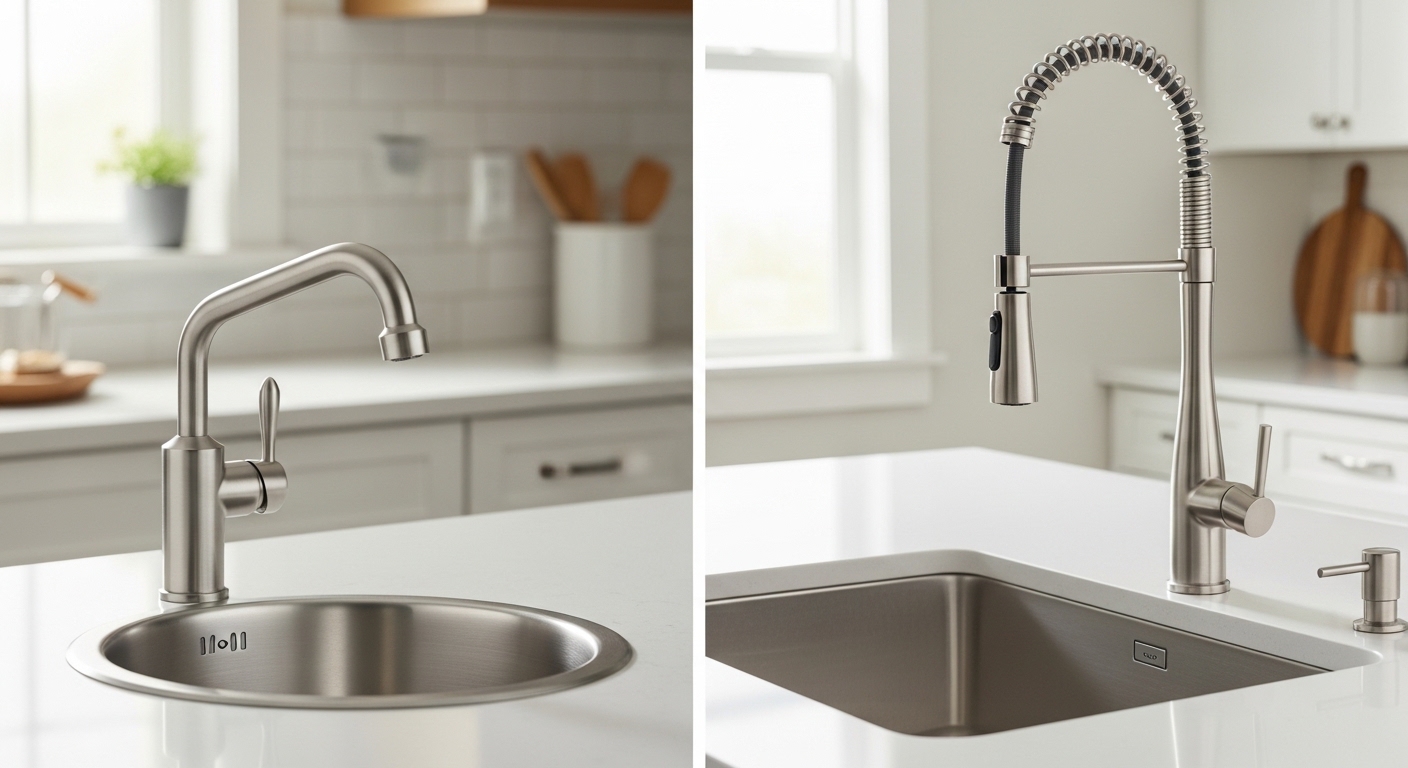
If you’re standing in a showroom or scrolling product pages trying to settle the bar faucet vs kitchen faucet question, the honest answer is that they aren’t competitors — they’re built for two different jobs. One is a scaled-down faucet for a small secondary sink; the other is the workhorse over your main basin. Pick the wrong one and you’ll either drown a tiny bar sink in spray or struggle to rinse a stockpot under a stubby spout. This guide breaks down the real differences in size, flow, mounting, and price, plus exactly which sink each one belongs over.
What’s the actual difference between a bar faucet and a kitchen faucet?
The core difference is scale and water volume. A bar faucet is physically smaller — usually 8 to 12 inches tall with a tighter spout reach and a flow rate around 1.0 to 1.5 GPM (gallons per minute). A kitchen faucet stands 12 to 18+ inches tall, reaches farther over the basin, and pushes 1.5 to 2.2 GPM so you can fill and rinse large cookware quickly.
Think of it this way: a bar faucet is the espresso cup and a kitchen faucet is the coffee mug. Both pour water, but they’re sized for completely different workloads. A bar faucet handles rinsing a wine glass, filling a kettle, or washing a cutting board at an island prep sink. A kitchen faucet has to clear a tall pot, spray down a sheet pan, and reach every corner of a wide double-bowl sink.
The single biggest mistake people make is treating them as interchangeable because they look similar online. They share the same plumbing connections and finishes, but the proportions are deliberately different. A bar faucet on a main sink leaves you bumping pots into a short spout; a kitchen faucet on a 14-inch bar sink throws water over the edge of the basin and visually overwhelms the space.
Bar faucet vs kitchen faucet: a side-by-side spec comparison
Here’s the quick version if you just want the numbers. The table below covers the specs that actually affect daily use — height, reach, flow, and the sink each one is designed for.
| Feature | Bar / Prep Faucet | Kitchen Faucet |
|---|---|---|
| Typical height | 8–12 in | 12–18+ in |
| Spout reach | 4–7 in | 8–10 in |
| Flow rate (GPM) | 1.0–1.5 | 1.5–2.2 |
| Intended sink size | Under ~15 in wide | 20–33 in wide |
| Spray feature | Often none, or small pull-down | Pull-down/pull-out sprayer common |
| Handle style | Usually single lever | Single or dual handle |
| Typical price | $50–$180 | $90–$400+ |
| Best for | Island prep, wet bar, butler’s pantry | Main cooking & cleanup sink |
One nuance worth flagging: the line between a “bar faucet” and a “prep faucet” is blurry — manufacturers use the terms almost interchangeably. Both describe the smaller secondary-sink faucet. If you see a compact pull-down listed as a “prep faucet,” it’s the same category as a bar faucet, just with a small spray head added. For a deeper look at that style, our guide on whether a bar faucet with a side sprayer is worth it for a small prep sink walks through the trade-offs.
Which sink does each faucet actually belong over?
Match the faucet to the sink, not to your wish list. A bar faucet belongs over any secondary basin under roughly 15 inches wide and 6 inches deep — island prep sinks, wet-bar sinks, butler’s pantry sinks, and outdoor kitchen prep stations. A kitchen faucet belongs over your primary sink, the wide, deep basin where you wash dishes and cookware.
The depth of the sink matters as much as the width. Bar sinks are shallow — often only 5 to 6 inches deep — so a tall high-arc kitchen faucet sits too far above the bottom and splashes hard every time water hits the basin. A bar faucet’s lower spout keeps the stream short and contained. On the flip side, a main sink is 8 to 10 inches deep, and a short bar-faucet spout forces you to crouch and shove pots underneath it.
- Bar faucet: island prep sink, wet bar, butler’s pantry, coffee station, outdoor prep sink.
- Kitchen faucet: main kitchen sink, deep single-bowl basins, large double-bowl sinks, farmhouse/apron sinks.
- Either can work: a medium “all-in-one” sink (16–18 in) where you do light prep but no big cookware — lean toward a compact kitchen faucet here.
Can I use a kitchen faucet on a bar sink (or vice versa)?
You physically can, but you usually shouldn’t. The plumbing connections are identical — both use standard 3/8-inch supply lines and fit standard 1.25 to 1.5-inch mounting holes — so nothing stops you mechanically. The problem is proportion and performance, not compatibility.
Put a full-size, high-arc kitchen faucet on a small bar sink and you get three issues: water splashes over the shallow basin’s edge, the faucet visually swallows the small sink, and the spout often overhangs past the back of the basin. Go the other direction — a short bar faucet on a deep main sink — and you can’t fit a stockpot, your pull-down sprayer (if any) is too short to reach the corners, and rinsing becomes a chore.
That said, there’s one legitimate crossover: a compact single-handle kitchen faucet on a mid-size sink that doubles as light prep. If your “bar” area is really a generous 18-inch basin, a smaller kitchen faucet can be the smarter pick. Before you commit either way, confirm the hole count, deck thickness, and spacing match — our walkthrough on how to check faucet compatibility before buying saves you from a return.
Does a bar faucet have lower water pressure than a kitchen faucet?
Not lower pressure — lower flow. Pressure (measured in PSI) comes from your home’s plumbing and is the same at every tap. What differs is the flow rate (GPM), which the faucet’s aerator and internal cartridge control. Bar faucets are typically capped around 1.0–1.5 GPM, while kitchen faucets allow 1.5–2.2 GPM, so the kitchen faucet delivers more water per second even though the PSI is identical.
This matters because people sometimes complain a new bar faucet feels “weak.” It isn’t broken — it’s just metered for a small sink where you don’t need a firehose. If you genuinely want stronger flow at a prep sink, look for a bar faucet rated at 1.5 GPM rather than 1.0, and check the aerator type. If an existing faucet feels weak when it shouldn’t, the cause is usually a clogged aerator or supply issue, not the faucet category — our explainer on how water pressure affects faucet flow covers the diagnostics.
How much do they cost, and is a bar faucet cheaper?
A bar faucet is usually cheaper, but not by a huge margin. Quality bar faucets run roughly $50–$180, while kitchen faucets span $90–$400+ depending on spray technology, finish, and whether they’re touchless. You’re paying for size, spray features, and the heavier-duty cartridge in a kitchen faucet — a bar faucet has less hardware, so it costs less.
Don’t shop on sticker price alone, though. The cheapest faucets in either category often use plastic cartridges and thin zinc bodies that fail within a few years. A solid-brass body with a ceramic-disc cartridge costs a little more upfront and lasts far longer — and it’s the single best predictor of whether a faucet drips early. If you’re budgeting a full swap rather than a like-for-like replacement, our breakdown of how much it costs to replace a kitchen tap in 2026 lays out parts, labor, and where the money actually goes.
What about installation cost?
Installation is nearly identical for both — same supply lines, same deck-mount process, same 30–60 minutes for a confident DIYer. If you’re paying a plumber, expect $100–$250 in labor regardless of which faucet you choose. The one variable is hole count: a single-hole bar faucet is the simplest install, while a kitchen faucet with a separate sprayer or soap dispenser needs extra deck holes.
Do bar and kitchen faucets come in the same finishes and styles?
Yes — and that’s exactly why so many kitchens use a matched pair. Both faucet types come in the same core finishes: chrome, brushed/stainless nickel, matte black, oil-rubbed bronze, and champagne bronze. Manufacturers deliberately offer bar and kitchen faucets in matching collections so your prep sink and main sink coordinate.
If you want a designer-grade look, buy both faucets from the same family so the spout curve, handle shape, and finish match exactly. Mixing two random brands often means two slightly different “brushed nickels” sitting a few feet apart — close enough to notice they don’t match. A pull-down kitchen faucet pairs naturally with a smaller pull-down bar faucet; if a pull-down is on your shortlist, our pull-out kitchen faucet buying guide explains the hose, weight, and docking differences to look for.
Single-handle vs dual-handle — does it differ by type?
Mostly yes. Bar faucets are overwhelmingly single-handle because space is tight and you want one-handed operation while prepping. Kitchen faucets come in both single-handle (easier one-handed temperature control with messy hands) and dual-handle (classic bridge or widespread looks). For a busy main sink, single-handle is the practical favorite; for a traditional kitchen aesthetic, dual-handle bridge faucets still have a strong following.
How do I choose the right one in 5 minutes?
Run through this quick checklist and the decision usually makes itself. Measure first, then match the faucet to the sink’s real dimensions and your tasks.
- Measure the sink width. Under ~15 in → bar faucet. 20 in or more → kitchen faucet.
- Measure the depth. Shallow (5–6 in) → keep the spout low (bar faucet). Deep (8–10 in) → go high-arc kitchen faucet.
- List your tasks. Rinsing glasses and light prep → bar. Washing pots and sheet pans → kitchen.
- Check clearance behind the sink. Low window or cabinet → a high-arc faucet may not fit; a lower bar or low-profile kitchen faucet works better.
- Confirm hole count and spacing on your existing sink or countertop before ordering.
- Match the finish to your other fixtures (or intentionally contrast — both are fine if deliberate).
If you’re outfitting an island with both a main and prep sink, the cleanest result is a matched kitchen-and-bar faucet pair from one collection. If you only have a single main sink, skip the bar faucet entirely — it’s the wrong tool for that basin.
FAQ
Is a bar faucet the same as a prep faucet?
Essentially, yes. “Bar faucet” and “prep faucet” both describe the smaller secondary-sink faucet, and manufacturers use the terms interchangeably. A prep faucet sometimes adds a small pull-down sprayer, but the size, height, and intended use — a compact secondary sink — are the same.
Can a bar faucet be used as a main kitchen faucet?
It’s not recommended. A bar faucet’s short spout and lower flow make washing pots, pans, and sheet trays awkward at a deep main sink. If your main sink is small (under 18 inches) and you never wash large cookware, a compact kitchen faucet — not a bar faucet — is the better minimal option.
Why does my bar faucet splash so much?
Usually because the faucet is too tall for the shallow sink, so water falls a long way and bounces. A bar faucet should keep the stream short. If splashing started recently, check the aerator — a clogged or missing aerator turns a smooth stream into a hard, splashy jet. Cleaning or replacing the aerator fixes most cases.
Do bar and kitchen faucets use the same plumbing connections?
Yes. Both use standard 3/8-inch compression supply lines and fit standard sink/deck mounting holes (about 1.25–1.5 inches). That’s why swapping one for the other is mechanically possible — the issues are size and flow, not connection type. Always verify your hole count and deck thickness before buying.
Should the bar faucet match the kitchen faucet?
For the most cohesive look, yes — buy both from the same collection so the finish and styling match exactly. Intentional contrast (a matte black bar faucet beside a chrome kitchen faucet) can look great too, but accidental near-matches from different brands usually look like a mistake. Decide deliberately.
Which lasts longer, a bar faucet or a kitchen faucet?
Longevity depends on build quality, not category. A solid-brass body with a ceramic-disc cartridge — in either a bar or kitchen faucet — typically outlasts a thin zinc body with a plastic cartridge by many years. Look for that construction and a lifetime or long-term warranty rather than assuming one type is inherently more durable.
The bottom line
Bar faucet vs kitchen faucet isn’t really a versus at all — it’s about matching the faucet to the sink. Use a bar faucet for a small prep, island, or wet-bar sink, and a kitchen faucet for your main basin. Measure your sink, weigh your tasks, and if you have two sinks, a coordinated pair gives you the cleanest, most functional result.
Author note: This guide was written by the KES product team, which has spent over a decade designing and testing kitchen and bath faucets. At kesfaucet, our faucets use solid-brass bodies and ceramic-disc cartridges, are tested to industry durability cycles for handle and cartridge life, and are backed by our manufacturer warranty. We recommend choosing fixtures certified to recognized lead-free and flow standards (such as cUPC/NSF) for your home’s drinking-water taps.
您好!请登录